

Operations
Part of Media buying agencies operations: campaign governance guide
Quality checks for media buying, from brief to change record
Media buying agencies quality checklist for England: inspect briefs, buying controls, creative approval, privacy, measurement and change records.
Use this media buying agencies quality checklist to inspect evidence, not polish. A pass means the agency can show what was approved, what entered the buying system and what actually ran.
What to take away
- Platform estimates must stay labelled as estimates and never presented as delivered results.
- On the next review, inspect changed settings and earlier failures before sampling unchanged work.
Brief and plan
- Confirm that the signed brief identifies the objective, audience, England or wider UK geography, dates, budget boundary and exclusions.
- Make the plan traceable to that brief. Channel choices should have a stated reason and named owner.
- Separate observed client data, publisher information, platform forecasts and agency judgement.
- Define the response or conversion event before comparing proposed tactics.
- Record any assumption that could materially change reach, cost exposure or measurement.
Stop the review if the plan relies on a different geography or objective from the approved brief. A plausible plan is still the wrong plan when it answers another question.
Brief and plan checks
- Signed briefobjective, audience, geography, dates
- Budget boundary and exclusions confirmed
- Plan traceable to brief, channel reasons
- Separate client, publisher, platform, agency data
- Define conversion event before comparing tactics
- Record assumptions affecting reach or cost
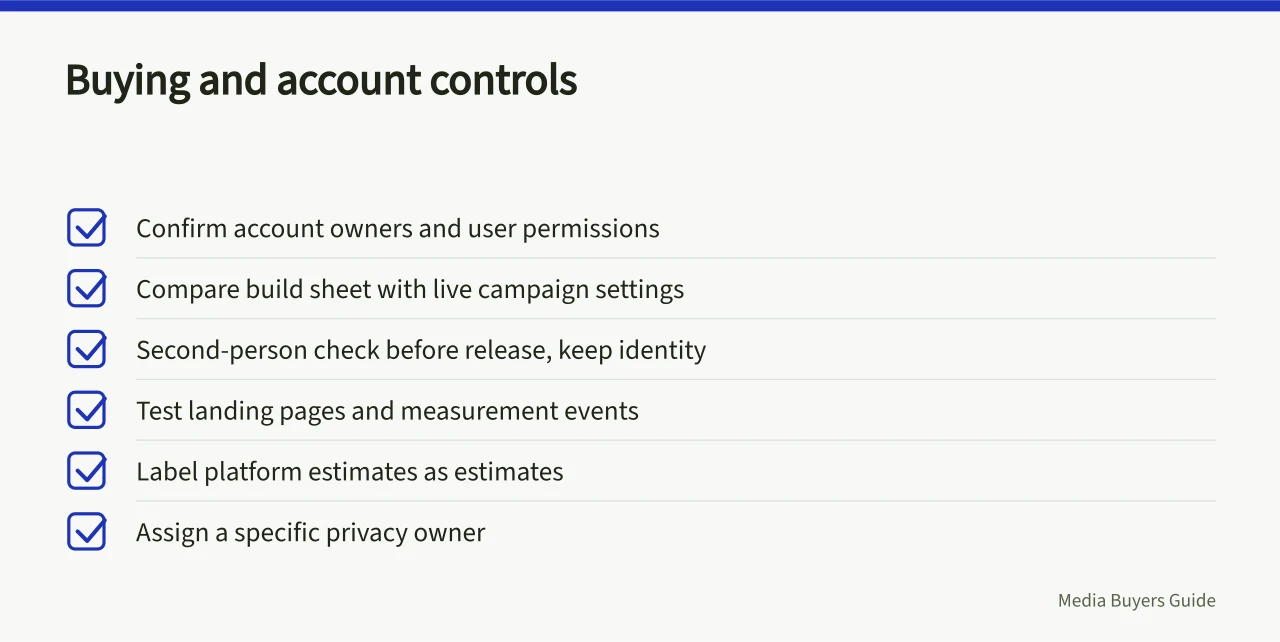
Buying and account controls
- Check who owns each advertising account and who can create users, alter billing or export data.
- Compare campaign names, dates, audience settings, locations, exclusions and budget controls with the approved build sheet.
- Require a second-person check before release. Keep the checker's identity and time with the campaign record.
- Test landing-page destinations and the agreed measurement events.
- Keep platform estimates labelled as estimates. Do not present them as delivered results.
Privacy needs a specific owner. The relevant ICO document is 'Guidance on the use of storage and access technologies', specifically the page 'How do the rules apply to online advertising?'.
According to the UK Information Commissioner's Office guidance on online advertising, consent is required when storage and access technologies support advertising selection, delivery, tracking or profiling. It also addresses information about data sharing and user control. Application to a campaign needs a qualified review; a tick in a spreadsheet cannot establish compliance.
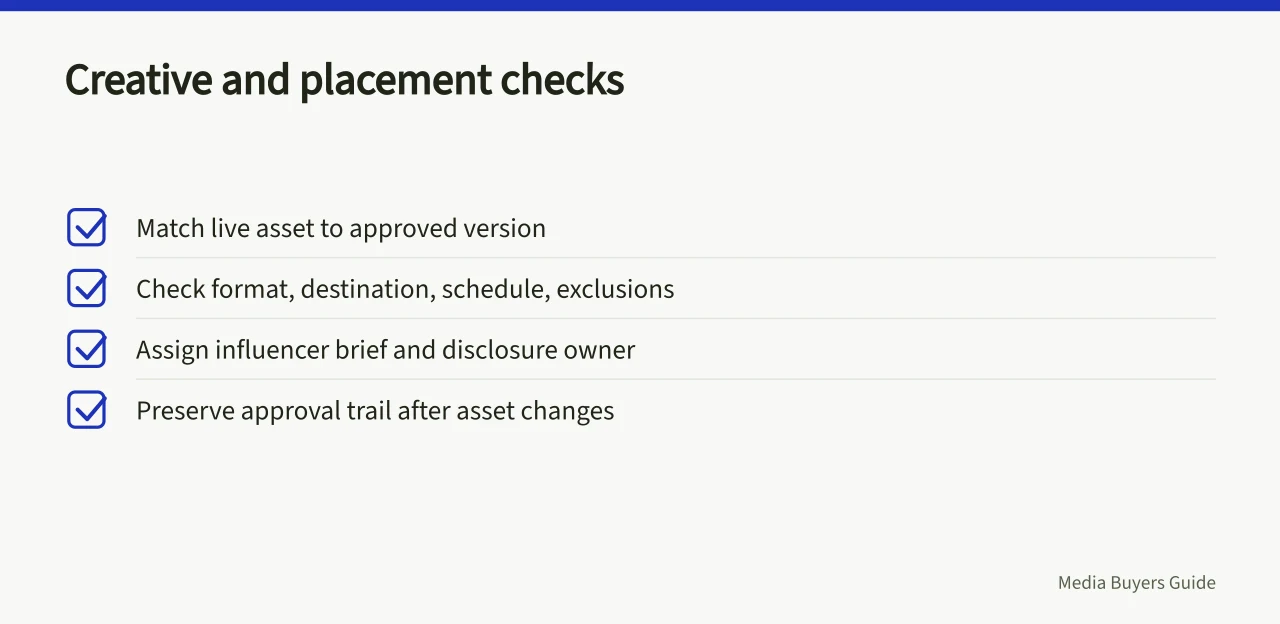
Creative and placement checks
- Match every live asset to an approved version and claim record.
- Check format, destination, schedule and placement exclusions in the buying interface.
- For influencer activity, assign responsibility for the creator brief and disclosure review.
- Preserve the approval trail when an asset changes after sign-off.
The ASA/CAP resource 'Influencer marketing: key advice and resources' is the hub. The UK-focused ASA and CAP influencer resource hub covers disclosure, affiliate marketing and social advertising for brands, agencies and creators.
Reporting and change control
- Reconcile delivery against the agreed scope, using the same dates and definitions.
- Log material edits with the observation, decision, person responsible and timestamp.
- Give the client access to the reports and source exports promised in the contract.
- Explain missing or late data instead of filling gaps with zeros.
- Escalate unexpected spending, unsafe placement, measurement failure or an unapproved claim immediately.
For a worked example, a change log entry can read: Observation: landing page returned 404 on affected placements. Decision: pause those placements. Owner: campaign manager. Timestamp: date and time of the check. That record shows what changed, who decided and when.
Reviews and endorsements also need evidence of origin and disclosure. The CMA collection 'Reviews and social media endorsements: what businesses and content creators must know' is the relevant guidance. The UK Competition and Markets Authority guidance collection addresses businesses, brands, creators, media agencies and review publishers.
Decide the outcome
Mark each line passed, failed, not applicable or unresolved. Add the evidence location and owner. A failed control needs correction; an unresolved high-risk point needs a release decision from the person with authority. Do not average serious failures into a reassuring overall score.
Keep the completed checklist with the corresponding plan version and account export. On the next review, inspect changed settings and earlier failures first, then take a fresh sample of unchanged work.
Archive the reviewer's notes with the result as well.
Before you act
- Is the signed brief in front of you with objective, audience, geography, dates and budget?
- Can you name the account owner and the person who can alter billing?
- Is the second-person release check recorded with a name and time?
- Does every live asset map to an approved version and claim record?
- Will the change log hold observation, decision, owner and timestamp?
- Are evidence locations and owners set for each passed, failed, unresolved or not applicable line?
Common questions
What does a pass on this media buying checklist actually mean?
See the opening section. The checklist tests traceability, not predicted results.
When should a reviewer stop the review entirely?
The stop rule sits in Brief and plan. Apply it before the buying review continues.
How should a reviewer handle failed and unresolved controls?
The handling rules sit in Decide the outcome. Apply the release decision there.