

Reviews
How to review media buying agencies for brief fit, not reputation
A buyer's method for reviewing media buying agencies in England: set gates, screen evidence, compare proposals, check contracts and record a fair decision.
Useful media buying agencies reviews answer a conditional question: which candidate fits this advertiser's brief, controls and evidence needs? They cannot prove a universal winner. No agency is named or ranked here; this guide covers the method a buyer can apply to any shortlist.
This guide is for organisations buying media for audiences in England. It takes a buyer from a written need through discovery, screening, proposal comparison and contract checks. Its output is a reasoned appointment record, not a star rating.
What to take away
- A review answers which agency fits this brief, not which agency is best.
- Fix decision criteria and evidence rules before any agency names enter the room.
- Separate pass conditions from preferences so a control gap cannot hide in an average.
- Candidate material is provider-selected, so treat it as a claim, not proof.
- Keep publisher-reported activity distinct from client-accepted outcomes and show both if they disagree.
Research note and editorial boundary
Research closed on 5 September 2026. England is the practical focus. Sources covering the UK or Great Britain retain those labels, and global product documentation is not treated as English market evidence.
Evidence entered the review when it was available on a live first-party agency, platform, regulator, government or industry-body page and directly answered a stated criterion. For a named agency, a current agency-owned record would be mandatory. Independent sources were included for process, audience, regulatory or verification questions, not to infer a provider's performance.
The work excluded bought rankings, anonymous ratings, award tables, unverified testimonials, inaccessible product pages, supplier results presented as independent proof, and figures with unclear dates or geography. It is desk research only. No agency was approached, interviewed, commissioned or observed. No pitch, contract, invoice, advertising account, platform feature, audience plan or result was tested.
The site has no affiliate link, sponsorship, free access, paid inclusion or commercial relationship connected with this guide. The author and named human reviewer are not assigned, so publication remains blocked. Any later relationship must be stated beside the affected material.
Agree the brief, the unit and the gates
Write one sentence describing the appointment. It should identify the advertiser, problem, relevant audience, media geography, working period and result the organisation accepts. Add constraints such as regulated categories, internal skills, existing technology, required office coverage and transition dates.
Then decide the unit being compared. An agency group, local office, delivery team and legal entity are not interchangeable. Neither are planning credentials, a written proposal and observed service. Switching between them lets a strong group reputation cover a weak answer from the actual team.
Set pass conditions separately from preferences. A non-negotiable account-ownership clause might be a gate, while presentation style is usually a weighted judgement.
Illustrative gate list for a regional retail brief, completed before proposals open:
| Gate | Evidence required | Status |
|---|---|---|
| Contracting entity | Companies House record plus signed confirmation | Clear |
| Account ownership | Contract clause naming the advertiser as account owner | Clear |
| Data return | Format, frequency and timescale agreed in writing | Qualified, format due before signature |
| Audit rights | Clause allowing advertiser audit of media records | Not yet clear |
A qualified pass carries a named action and a date to close it.
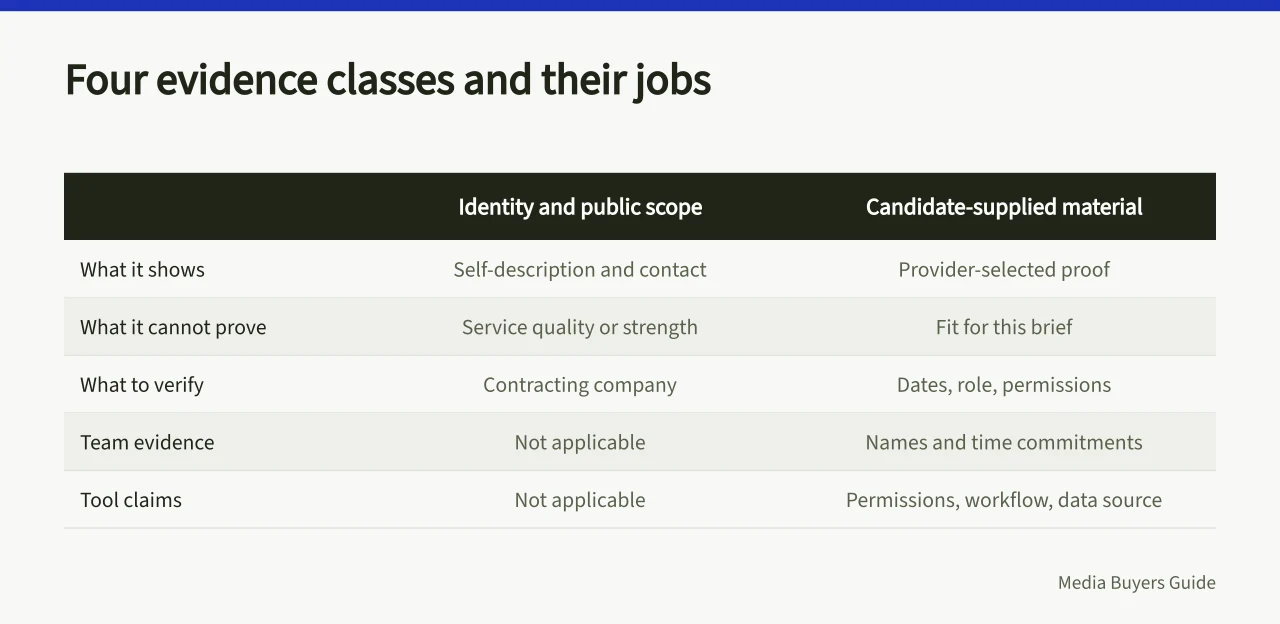
Four evidence classes and the question each one answers
Identity, supplier claims, independent context and buyer records. Read them together; a review that leans on only one is incomplete.
Identity and public scope
First-party pages establish how an agency describes itself, where it says it operates and which contact route it publishes. Confirm the contracting company independently. Companies House explains what its UK register search contains, but also warns users to inspect records for themselves. A filing does not prove service quality, financial strength or relevant experience.
The IPA member directory can broaden UK discovery. Membership is neither an England census nor a quality score. Use it to find possible candidates, then require each named entry's own live page and proposal.
Candidate-supplied material
Credentials, case studies, team biographies, process diagrams and references can show what a provider is willing to stand behind. Ask for definitions, dates, the agency's exact role and permission to contact an appropriate client. Do not transplant an outcome from another advertiser into a forecast for this brief.
Treat the proposed team as evidence only when names, time commitments and replacement rules are written down. A network capability that the account cannot access is not part of the offer. Likewise, a tool name says little without permissions, workflow, data source and output.
Independent context
Independent or jointly produced guidance helps frame questions. The 2019 IPA and ISBA Finding an Agency guide addresses UK review timing, procurement, briefs, evaluation and fair pitch practice. It is not an endorsement of a candidate, and its publication date calls for current checks on law, contracts and technology.
Audience context must match the buying geography and medium. Ofcom's Media Nations 2026 supplies dated UK evidence with separate nations material. It can inform questions about viewing and listening, but cannot demonstrate an agency's reach, buying price or campaign effect.
Buyer-owned evidence
The most relevant material often sits inside the advertiser: accepted sales records, lead validation, previous invoices, tagging notes, brand studies and service logs. Define who owns each dataset and what period it covers. A past result becomes only a reference point when the audience, offer, season, channel and measurement rules remain comparable.
Keep publisher-reported activity distinct from client-accepted outcomes. If the two disagree, show both and investigate. Do not silently relabel a modelled or attributed action as an order.
Move candidates through controlled stages
Allow time for this work. A typical review runs across several weeks. The timetable is set by the number of invited firms, the depth of evidence requested, the availability of the advertiser's own records and the speed of legal review. As a planning rule of thumb, budget a half day per evaluator for each written proposal.
Discover broadly, invite deliberately
Search by capability, sector constraints, location and operating model. Record why every longlist name might fit. Remove a candidate only against an explicit rule, and keep the reason. The longlist need not include every English agency, but its search boundaries should be reproducible.
Move candidates through controlled stages
- Discover broadly and record fit
- Invite deliberately with equivalent brief
- Screen with factual gates
- Compare written proposals on one scale
Before issuing the brief, ask whether the opportunity, budget and timetable justify the work requested. Supply equivalent information to every invited firm. Protect confidential data and pitch ideas. A fair process improves the evidence because candidates know what to answer and how they will be judged.
Screen with factual gates
Use a short written questionnaire for matters that can stop the appointment. Typical subjects include legal identity, conflicts, office and staff availability, channel remit, subcontractors, platform-account control, data return, information security and willingness to accept audit provisions.
A pass means the supporting record exists, not that an evaluator feels reassured. Allow clarification under the same rules for all. Record qualified passes and the action needed to close them.
Compare written proposals on one scale
Ask for responses in a common order and impose consistent assumptions about budget, dates and deliverables. Establish weights in advance. Each evaluator should score alone, cite a proposal page or clarification, and give a brief reason before the group meets.
Illustrative scoring sheet, filled in for one shortlisted proposal. Weights are set before proposals arrive and total 100:
| Criterion | Weight | Raw score, out of 10 | Weighted mark |
|---|---|---|---|
| Plan quality against the brief | 30 | 7 | 21 |
| Named team and committed hours | 25 | 8 | 20 |
| Measurement and reconciliation | 25 | 6 | 15 |
| Commercial terms | 20 | 5 | 10 |
| Total | 100 | 66 |
The gate status sits beside this sheet. A high total does not clear a failed gate, and a low-confidence mark is flagged rather than rounded up.
Moderation is for understanding differences, not forcing identical marks. Preserve dissent where one assessor sees a risk others accept. If new information changes a mark, keep the old value and the reason for revision in the audit trail.
Chemistry sessions may reveal communication habits, but they are staged encounters. Give each team comparable people, time and questions. Do not call the session a service trial or infer campaign competence from an engaging presentation.
Negotiate against the winning answer
The contract should translate the proposal into obligations. Map scope, named roles, service levels, approvals, fees, media payment, use of affiliates, inventory positions, rebates, records, data, security, audit, termination and transition. Ask a qualified English solicitor to review the final terms where appropriate.
ISBA's contract compliance audit guidance offers UK advertiser guidance on remuneration and stewardship. It does not certify a contract or guarantee transparency. Use it to formulate requests and then examine the negotiated wording.
Trade-offs and the action each one requires
An agency can be strong on one brief and unsuitable on another.
Buyer situations and trade-offs
Small internal media team
- Prioritise
- Named delivery capacity
- Trade-off
- Breadth adds cost
- Decision test
- Cover every task?
Several English regions
- Prioritise
- Office responsibility
- Trade-off
- Fragmented accountability
- Decision test
- Who owns national plan?
Heavy programmatic buying
- Prioritise
- Supply routes and controls
- Trade-off
- Obscured intermediaries
- Decision test
- Reconstruct spend?
Strict outcome measurement
- Prioritise
- Event definitions and exports
- Trade-off
- Attribution may differ
- Decision test
- Traceable outcomes?
| Buyer situation | Evidence to prioritise | Trade-off to expose | Action to agree before appointment |
|---|---|---|---|
| Small internal media team | Named delivery capacity and operational ownership | Breadth may add cost or distance from specialists | Name the delivery owner and their weekly hours in the contract. |
| Several English regions | Office responsibility, local knowledge and one governance route | Distributed teams can fragment accountability | Agree which office owns the national plan and how local conflicts are escalated. |
| Heavy programmatic buying | Supply routes, controls, fees, logs and account permissions | Automation can obscure intermediaries and commercial positions | Require a spend reconstruction test and a list of every intermediary in the route. |
| Strict outcome measurement | Event definitions, raw exports and reconciliation to accepted results | Platform attribution may differ from business records | Fix the event dictionary and the export format before the first invoice. |
The IAB UK guide to programmatic advertising describes roles, auctions, data and supply-chain concepts for UK readers. It is useful vocabulary, not proof that a specific route is efficient or safe.
Avoid totals that pretend all categories compensate for one another. Show gate status beside weighted marks. Add a confidence label based on evidence completeness, not enthusiasm. A close numerical result may require more clarification rather than a false decimal-place winner.
Separate systems promised from delivery observed
Platform and tool statements should be checked against the owner's current documentation. For example, Google Ads documents distinct conversion routes for website, app, calls and offline activity on its global help page. That supports a configuration question. It does not show that the proposed agency will select the right event, reconcile it to business records or interpret attribution carefully.
Responsibility map to request
- Account creation
- Access approval
- Tagging
- Event definitions
- Quality checks
- Report export
- Incident response
Ask finalists for a responsibility map covering account creation, access approval, tagging, event definitions, quality checks, report export and incident response. A demonstration using supplied fictional information can expose assumptions. It remains a demonstration, not a hands-on review by this publication and not evidence of future results.
Data governance also belongs in selection. The ICO's UK guidance on storage and access technologies covers technologies used in online advertising, including cookies and pixels. Application depends on the facts, and this guide does not provide legal advice. Require the candidate to explain its proposed data flow and obtain specialist review where needed.
Publish or approve a bounded conclusion
A decision record should state the brief, eligible pool, inclusion rule, exclusions, evidence period, geography, gates, weights, individual scores, moderation changes, conflicts and open conditions. Name the people who assessed it. Attach the final commercial comparison and explain why the chosen offer fits better under the published criteria.
Illustrative decision record entry: brief, national retail media in England, 12 month term, outcome measured on accepted sales. Eligible pool, eight firms identified, five met the gates. Excluded, two for no live first-party record, one for an unresolved conflict.
Weights, plan 30, team 25, measurement 25, commercial 20. Chosen, the highest scoring firm on 71 of 100 after moderation from 68. Open condition, exit and data return schedule due before signature. Assessed by the procurement lead and the head of marketing.
Decision record contents
- Brief and eligible pool
- Inclusion rule and exclusions
- Evidence period and geography
- Gates and weights
- Individual scores and moderation
- Conflicts and open conditions
- Named assessors
If the conclusion becomes a public review, separate verified fact, supplier claim and editorial judgement in the text. The CMA's UK guidance collection on reviews and endorsements is relevant to genuine and incentivised content. It does not validate any agency recommendation.
Date the conclusion and say what would trigger an update. Correct material errors visibly. Recheck agency identity, product details and external links immediately before release. A transparent "insufficient evidence" finding is preferable to filling a gap with reputation or guesswork.
Before you act
- Write one sentence describing the appointment and its constraints.
- Decide whether you compare a group, office, team or legal entity.
- Set pass conditions separately from weighted preferences.
- Confirm the contracting company independently before shortlisting.
- Score written proposals alone against pre-set weights.
- Map the proposal into contract obligations before signing.
Common questions
What should a media buying agency review actually decide?
It produces a documented choice between candidates for one advertiser's brief. The record shows the criteria, the evidence behind each mark and the conditions still open. A review cannot establish a universal best agency, and it should not be presented as one.
How should candidate-supplied credentials and case studies be treated?
Use them to frame questions, not to settle them. Ask the agency to state its own role, the dates, the media mix and the measurement rule behind each case study. Permission to speak to a comparable client is stronger than a written summary. If the outcome cannot be checked against the buyer's own records, treat it as context.
Why keep buyer-owned evidence separate from agency claims?
The advertiser's own accepted sales, lead validation, invoices and service logs describe what actually happened. Agency dashboards often report platform activity under different definitions. Keeping the two sets apart shows where a definition, a tracking gap or a reconciliation problem sits. If they disagree, publish both and investigate before drawing a conclusion.
When is the review ready to publish or act on?
Only after the named entities have live first-party records, every comparison uses consistent units, conflicts are disclosed and no desk research is described as testing. Assign the author, human editor and any legal or privacy reviewer. Until those checks are complete, keep both the article and the procurement conclusion on hold.
In this guide
- An unranked media agency shortlist for England, with the inclusion rules shownMedia buying agencies best providers in England: an unranked shortlist with first-party evidence, inclusion rules, practical fit notes and limits.
- Media buying agencies product comparison: Google Ads, LinkedIn and Amazon DSP recordsMedia buying agencies product comparison: what Google Ads, LinkedIn Campaign Manager and Amazon DSP publish on access and reporting for UK buyers.
- Three media agency evidence cards, separating verified facts from agency claimsMedia buying agencies agency reviews in England: read three evidence cards that separate verified public facts, agency claims and unanswered buyer questions.
- Media buying agencies selection checklist: money, scenario, transitionA media buying agencies selection checklist for finalists: inspect the money route, run one scenario, test the transition and keep a decision file.