

Reviews
Part of How to review media buying agencies for brief fit, not reputation
Media buying agencies selection checklist: money, scenario, transition
A media buying agencies selection checklist for finalists: inspect the money route, run one scenario, test the transition and keep a decision file.
Finalists should be judged on what they can prove about money, reasoning and handover, not on the best presentation. After screening, the buyer inspects the money route, runs one scenario for everyone, tests the transition and files the decision. Earlier stages are covered in reviewing agencies for brief fit.
What to take away
- Inspect costs, principal buying, rebates and contract inspection rights before any presentation.
- Give every finalist the same fictional scenario and ask for assumptions first.
- Test the transition plan on a calendar.
- Stop any finalist that will not explain account ownership, data return or audit access.
- Record independent marks, minority concerns, contract departures and the decision trail.
Confirm the ground rules still hold
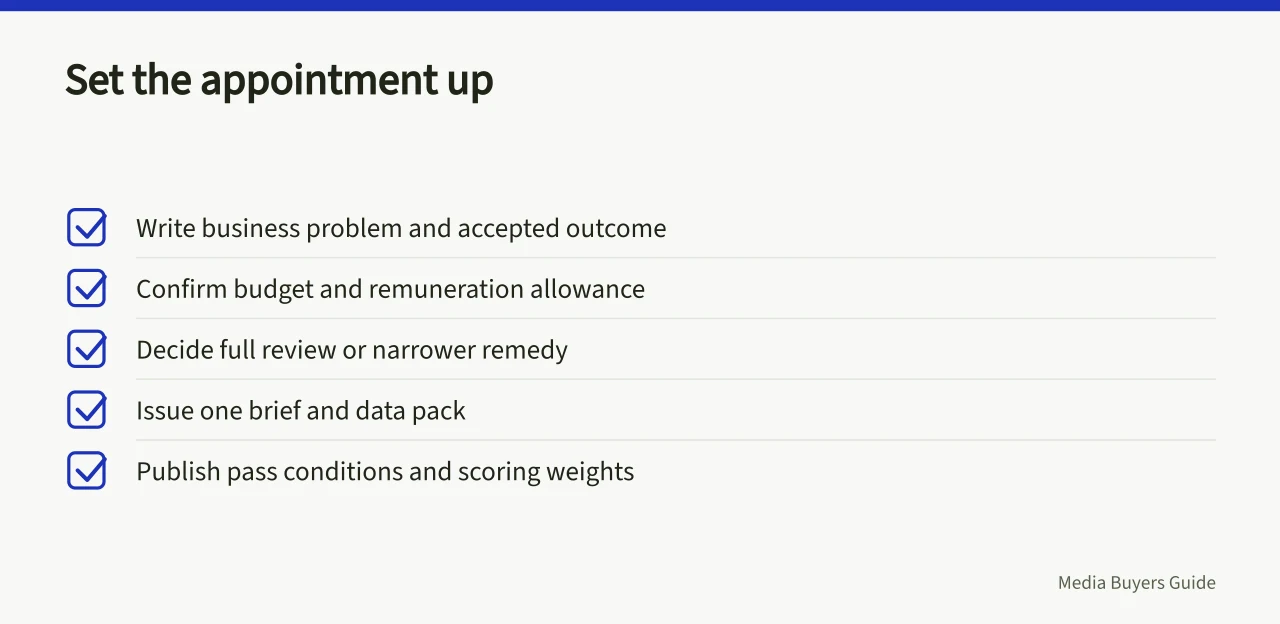
A finalist round is fair only if the rules were set before proposals arrived. Check that pass conditions and scoring weights were published, and that one brief, timetable, question set and data pack went to every candidate.
Inspect money and media routes first
Ask every finalist for all retainers, project charges, mark-ups, commissions, technology costs and pass-through expenses in comparable units. A proposal priced in different units cannot be compared, however good the presentation.
| Question to the finalist | Evidence to request | Done when | If it is refused |
|---|---|---|---|
| Where are you agent, and where principal? | A written statement for each route | Every route is labelled agent or principal | Stop |
| What value arises from client spend? | A list of rebates, credits and free inventory | The list is filed with the proposal | Keep open |
| What do the pass-through costs cover? | Each expense in comparable units | Costs sit side by side with other proposals | Keep open |
| What will the client be able to inspect? | Retention, invoice support and reconciliation timing | The terms fit the contract schedule | Stop |
Document rebates, credits, free inventory and other value arising from client spend in the file, and put record retention, invoice support, reconciliation timing and inspection rights into the contract schedule.
Inspect money and media routes
- Request retainers, mark-ups, commissions in comparable units
- Ask where agency acts as agent or principal
- Document rebates, credits and free inventory
- Put retention and inspection rights in contract
The ISBA agency contract compliance audit guidelines provide UK advertiser guidance on remuneration and money stewardship. They do not certify a contract or replace advice from a qualified solicitor.
Run one fictional scenario for every finalist
Give finalists the same fictional scenario and ask them to state assumptions before presenting a response. The aim is to see how each team reasons when the brief is incomplete, which a prepared pitch can hide.
- Issue the scenario to every finalist at the same time, with the same data pack.
- Ask each finalist to list its assumptions before it presents.
- Check whether audience sources, buying currencies and forecast periods match the English campaign brief.
- Separate platform-attributed actions from orders or outcomes accepted by the client.
- Ask who can export raw reports, change conversion definitions and remove user access.
Judge the assumptions rather than the polish. A finalist whose assumptions contradict the English campaign brief has shown the gap early, which is the point of the exercise.
Test the transition on a calendar
Ask each finalist for its transition plan and test it on a calendar, including data transfer, tracking checks and unfinished media commitments. A plan with no dates for these tasks has not been thought through.
Name who owns each handover task on both sides. Exit is part of selection, because the same schedule applies on the day the appointment ends.
Stop a finalist that will not disclose
A finalist can still be stopped. Any candidate that will not explain account ownership, data return or audit access leaves the process, whatever the rest of the proposal says. Verify the legal contracting entity and the office expected to serve the account.
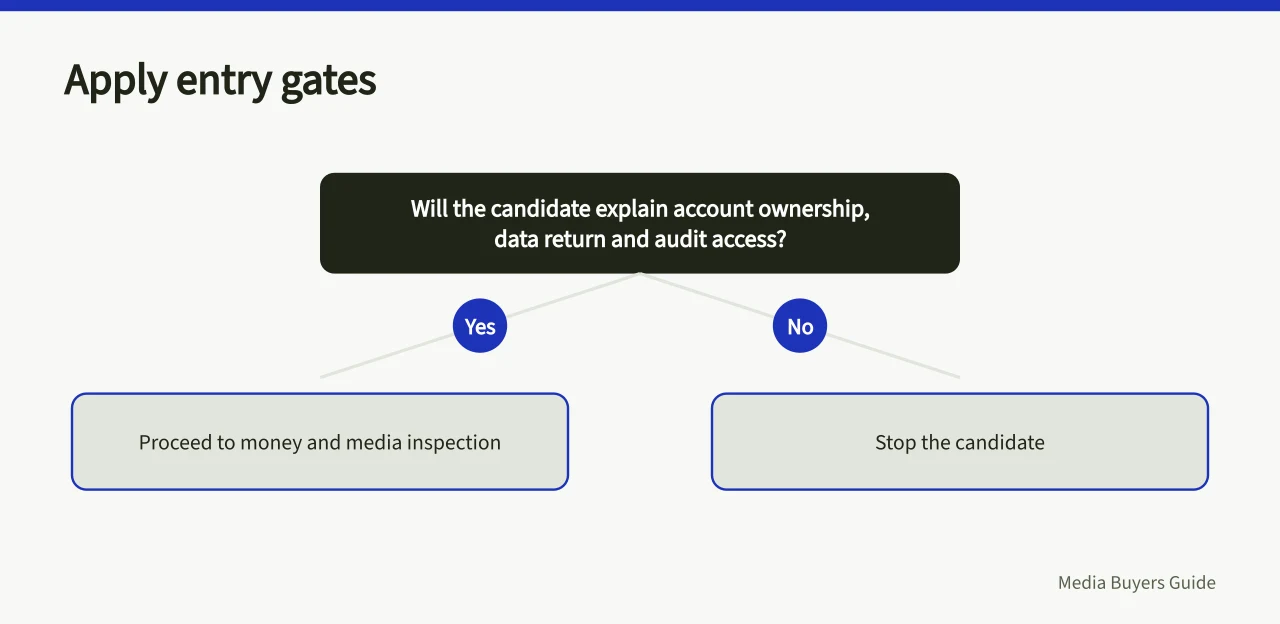
Worked gate example: the candidate names the legal entity that signs the contract, the person who owns the account data, and the route for exporting raw reports. A blank on any of the three fails the gate.
Companies House data is an identity check only. GOV.UK says you can set up free email alerts to tell you when a company updates its details, for example a change of director or address. That does not establish financial strength, service quality or relevant experience.
Build the decision file
The decision file is the buyer's record that the appointment followed its own rules. Keep minority concerns and failed gates visible rather than hiding them inside an average.
| Part of the file | What goes in it |
|---|---|
| Marks | Each evaluator's independent mark, cited to a proposal page or clarification |
| Gates | Failed and open gates, with the reason for each |
| Contract | Every negotiated departure from the winning proposal |
| Candidates | Consistent notifications, with confidential material protected |
| Follow-up | Owners and dates for onboarding checks, the first financial reconciliation and a relationship review |
Compare the final contract with the winning proposal and log each departure. Before signing, confirm current UK GDPR and PECR duties, the Advertising Standards Authority CAP Code and platform rules such as Google Ads consent mode.
The buyer should date every completed box and write a reason wherever it accepts an exception. The method is built for private and voluntary-sector buyers appointing agencies for activity in England. Public procurement, sector-specific advertising rules and devolved requirements need separate treatment.
Before you act
- Request all costs in comparable units and document rebates.
- Give every finalist the same scenario and ask for assumptions first.
- Test the transition plan on a calendar.
- Verify the legal contracting entity and apply the stop rules.
- Have evaluators mark independently and cite each mark.
- Log every negotiated departure from the winning proposal.
Common questions
What stops a finalist?
Any candidate that will not explain account ownership, data return or audit access leaves the process, whatever the rest of the proposal says. A blank on the contracting entity, the data owner or the raw-report export route fails the gate.
Why give every finalist the same fictional scenario?
It shows how each team reasons when the brief is incomplete. Ask for assumptions before the response, and separate platform-attributed actions from orders or outcomes accepted by the client.
What does the decision file hold?
Independent marks, failed and open gates, every negotiated departure from the winning proposal, candidate notifications and the follow-up owners and dates. It is kept so the decision trail survives the appointment.