
Foundations
What Cardiff and Belfast media buyers must know about S4C and UTV
Media buying agency teams buying S4C in Cardiff and UTV in Belfast face two very different audiences, and UK-wide plans usually under-serve both markets.
What to take away
- Any media buying agency placing Welsh-language spots needs to treat S4C as a Cardiff sales conversation, not a line in a UK-wide ITV or Channel 4 deal.
- UTV airtime is bought in Belfast through ITV's regional sales structure, and Northern Ireland ratings are measured on their own BARB panel.
- The two audiences differ in language, news habits, cross-border spill and platform mix, so one creative set rarely covers both.
- Buyers should record audience data source, language version, airtime split and compliance route before approval.
How S4C in Cardiff is bought
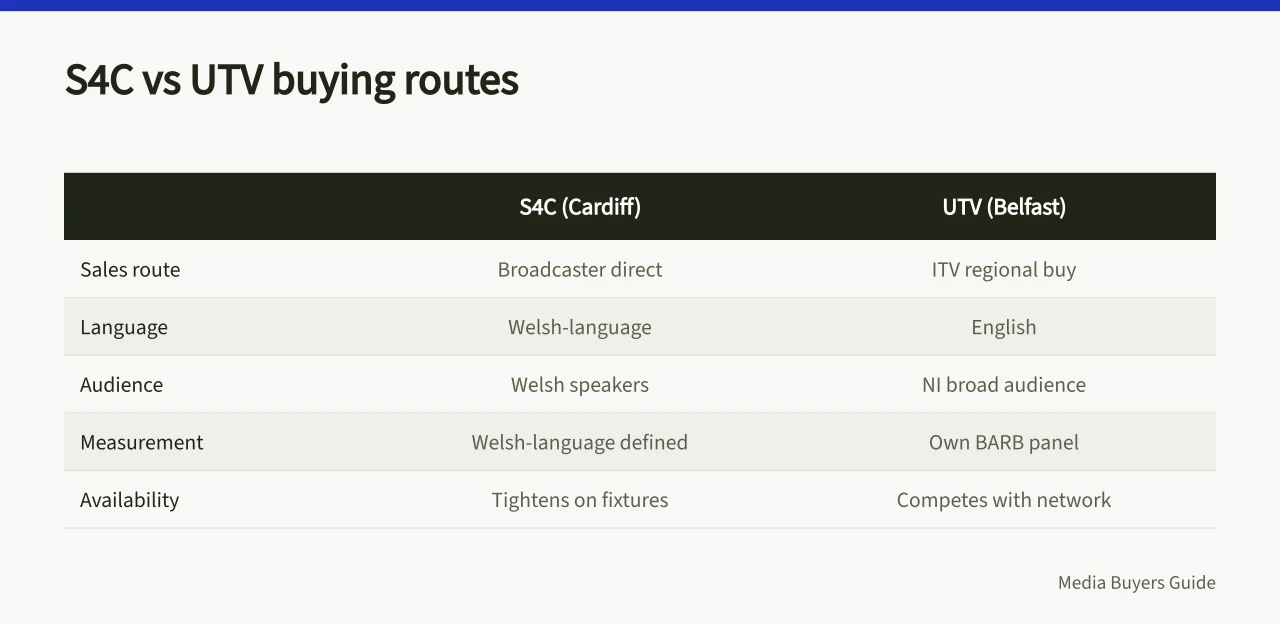
S4C is a Welsh-language public service broadcaster based in Cardiff. Its airtime is sold in Wales, and the buying conversation sits with the broadcaster's own commercial team rather than with a London agency trading desk. That matters because the inventory is finite and the audience is defined by Welsh-language ability, not by a postcode alone.
The team that handles this is S4C's commercial department, the in-house function for airtime and sponsorship enquiries. Ask it for the account handler covering your agency and for the current rate card, then keep both with the plan.
Planning starts with Welsh language policy. The Welsh language policy context sets out the statutory and policy backdrop that shapes Welsh-language provision and public expectations of it, which is what advertisers are buying into when they book S4C spots.
Spots are usually bought in Welsh, sometimes with English subtitles, and the creative must be cleared for the channel. A Welsh-language voiceover is not a translation afterthought. It is the asset. Buyers who treat it as a versioning cost tend to underinvest and then wonder why recall is flat.
The channel's schedule carries sport, drama, entertainment and children's programming, with a strong news and current affairs spine. Peak audiences cluster around those pillars, so a Cardiff media buying plan built only on cheap daytime weight will miss the viewers clients actually want.
Airtime is traded against Welsh-language programming commitments, which means availability tightens around key fixtures and major series. Book early for anything tied to a launch date. Late money in this market buys leftovers.
Budget signals for S4C airtime: cost per thousand is set by scarcity as much as by audience size, because Welsh-language inventory is finite. Daypart, programme, volume and lead time all move the number, and sport and major drama carry the highest rates.
Get an indicative cost per thousand in writing from S4C's commercial team before the plan is signed off. Treat that number as the benchmark for Wales rather than any UK average.
How UTV in Belfast is bought
UTV is the Northern Ireland ITV licence holder, headquartered in Belfast. Its airtime is sold through ITV's commercial structure, so a Belfast media buying campaign normally sits inside an ITV regional buy rather than a standalone deal. The practical consequence is that UTV inventory competes with the wider ITV network for priority.
The desk to call is ITV Sales, the network's in-house advertising sales house, which sells the UTV region alongside the rest of the ITV network. There is no separate UTV sales operation. Ask ITV Sales for the regional contact who owns Northern Ireland and record that name on the plan.
Northern Ireland audiences are measured on their own BARB panel, part of BARB's UK panel of about 5,100 homes. UTV's share of viewing there runs above ITV's UK-wide share, and UTV Live at 6pm is regularly among the region's most watched programmes. That concentration is why rates hold up when national demand is strong.
UTV rates are quoted regionally by ITV Sales, not as a national average. Cost per thousand moves with network demand, daypart and programme position, and a solus Northern Ireland deal prices differently from a national buy that happens to include the region.
Ask for both quotes before you choose. Compare the rate against the BARB cut for Northern Ireland, and treat small differences between programmes with care, because the region carries one of the smallest samples in that UK panel.
Cross-border advertising is the local complication. Republic of Ireland channels spill into Northern Ireland homes, and Northern Ireland services spill the other way. A Belfast buy that ignores that overlap is not buying the market as viewers experience it.
Local press, radio and out of home in Belfast work alongside UTV rather than under it. The regional pattern is not a national pattern scaled down. Each channel carries a distinct role, which is the logic set out in this guide to channel strategy.
Airtime is also subject to the statutory framework for UK commercial broadcasting and advertising. The Broadcasting Act 1990 is the starting point for how commercial television licences and advertising are constituted, and it is worth knowing when a client asks why regional licence areas behave differently from one another.
How the two audiences differ
Language is the first difference. S4C viewers are Welsh speakers or Welsh-language households, a self-selecting group with strong loyalty to the channel. UTV viewers are a broad Northern Ireland audience watching in English, with a large reach among adults who watch little else beyond the main channels.
News habits diverge. Welsh-language news on S4C and English-language news on BBC Cymru Wales and ITV Cymru Wales split the Cardiff audience by language and by time of day. In Belfast, UTV Live is a dominant early evening habit in a way that has no direct Cardiff equivalent.
Geography behaves differently. Wales has a north-south split, with Cardiff and Swansea distinct from north Wales audiences who also receive signals and services oriented toward north west England. Northern Ireland is compact, and Belfast dominates, but border areas and the north coast behave differently again.
Demographic structure differs too. The Population estimates from the Office for National Statistics underpin regional planning, and the age and household profiles of Wales and Northern Ireland are not interchangeable with the UK average. Weight them properly rather than defaulting to national splits.
Platform mix adds a further gap. S4C's younger audience is heavily digital, and its content travels through iPlayer and social clips as much as through linear. UTV's audience is older on average and more linear. One media mix will not serve both.
S4C, Cardiff
- Language
- Welsh, some subtitled English
- Sales route
- Broadcaster's Cardiff commercial team
- Audience measure
- Welsh-language audience, BARB
- Peak pillars
- Sport, drama, news, children's
- Main complication
- Finite Welsh-language inventory
- Digital weight
- High among younger viewers
UTV, Belfast
- Language
- English
- Sales route
- ITV regional sales structure
- Audience measure
- Northern Ireland BARB panel
- Peak pillars
- News, soaps, sport, entertainment
- Main complication
- Cross-border Republic of Ireland spill
- Digital weight
- Lower, more linear
Where UK-wide plans under-serve Cardiff and Belfast
A UK-wide plan is built to a national average. Wales and Northern Ireland are small enough that their regional weightings get smoothed away, and the money follows the biggest audiences. That is the structural gap, and it shows up in four places.
First, language. A UK-wide buy cannot accommodate Welsh-language creative unless someone deliberately carves it out. S4C ends up as a line item nobody owns, or it disappears entirely.
Second, inventory access. UTV sits inside an ITV regional buy, so a national deal may deliver Northern Ireland as an afterthought with no control over daypart or programme environment. If UTV matters to the client, it needs its own negotiation.
Third, measurement. National post-campaign reporting rarely breaks out Wales and Northern Ireland at a level that lets a buyer judge performance. Ask for the regional cuts before you sign, not after.
Fourth, compliance. Broadcast advertising is regulated by Ofcom under duties set out in the Communications Act 2003, and the Advertising Standards Authority applies the CAP Code across UK advertising. Regional creative still has to clear both, and Welsh-language copy needs its own review.
UK-wide plans also tend to skip the audience definition step. If you cannot say who you are buying in each nation, you cannot defend the spend. Knowing which fields every media plan should fill before approval is a useful discipline here.
Buying both markets in one plan
You can buy Cardiff and Belfast together without pretending they are the same market. The trick is to keep one plan with two clearly separated regional builds and a shared measurement spine.
Buying Cardiff and Belfast together
- Set separate Wales and NI objectives
- Build S4C element first
- Negotiate UTV inside ITV regional
- Add local channels around anchors
- Agree regional reporting cuts early
- Set separate objectives for Wales and Northern Ireland, with the Welsh-language audience named explicitly if S4C is in scope.
- Build the S4C element first, because Welsh-language inventory is the scarcest asset in the plan.
- Negotiate UTV within the ITV regional structure, holding daypart and programme positions as conditions.
- Add Belfast and Cardiff local channels around the two broadcast anchors, giving each a defined role.
- Agree regional reporting cuts at the planning stage, so post-campaign data arrives in usable form.
Budget split follows audience value, not population share. A brand with Welsh-language relevance should over-index in Wales. A brand with all-island or cross-border ambitions should weight Belfast and the border accordingly.
Worked example, illustrative only. A £100,000 campaign puts £20,000 into these two markets. For a brand with strong Welsh-language relevance, that £20,000 splits 55 per cent to S4C, 25 per cent to UTV and 20 per cent to Belfast and Cardiff local channels.
For a brand whose business sits mainly in Northern Ireland, reverse it: 20 per cent to S4C, 60 per cent to UTV and 20 per cent to local channels. Neither split follows population share, which would put roughly 5 per cent of the UK total in Wales and roughly 3 per cent in Northern Ireland.
Treat the percentages as a starting position for negotiation.
Creative needs two versions minimum, and often three: Welsh-language, English for Wales, and English for Northern Ireland. Build the versioning cost into the plan rather than absorbing it later.
Timing matters. S4C availability tightens around sport and major series, and UTV inventory tightens around network peaks. If both markets are in one campaign, book the Welsh-language element first and let the Belfast buy flex around it.
What to record before the buy is approved
Approval should not happen until the plan can answer basic questions about both markets. Use this checklist and keep the answers with the plan file.
Pre-approval checklist
- Audience definition for Wales and NI
- Language versions required
- Sales route per buy
- Daypart and programme positions held
- Regional reporting cuts agreed
- Compliance route per creative
- Budget split by nation
- Audience definition for Wales and for Northern Ireland, stated separately
- Language versions required, including whether Welsh-language copy is in scope
- Sales route for each buyS4C direct, ITV regional for UTV
- Daypart and programme positions held as conditions, not preferences
- Regional reporting cuts agreed with the measurement supplier
- Compliance route confirmed for each creative version
- Budget split by nation with the rationale written down
Confirm who signs off Welsh-language copy before it is produced, and file that name with the plan.
Then check the plan against a wider market view. Understanding England's media buying agency market helps you see what a genuinely regional buy looks like, and where a national plan has quietly substituted reach for relevance.
Finally, write down what you expect each market to deliver and why. If the numbers move against you, that record is the only way to tell whether the plan was wrong or the market was.