
Foundations
Part of Media buying agency vs media planning agency: which do you actually need?
Media buying agency vs media planning agency: which do you actually need?
Media buying agency vs media planning agency: how UK agency scope splits between planning and buying, and how to decide which of the two you need.
What to take away
- Media planning decides where the money goes: audience, channels, timing and budget split. For a media buying agency vs media planning agency, the choice turns on who holds the plan and who holds the price.
- Media buying turns that plan into bookings and prices, then checks what actually ran.
- If your plan is sound and the budget is small, buying on its own can be enough.
- If the plan is the problem, start with planning.
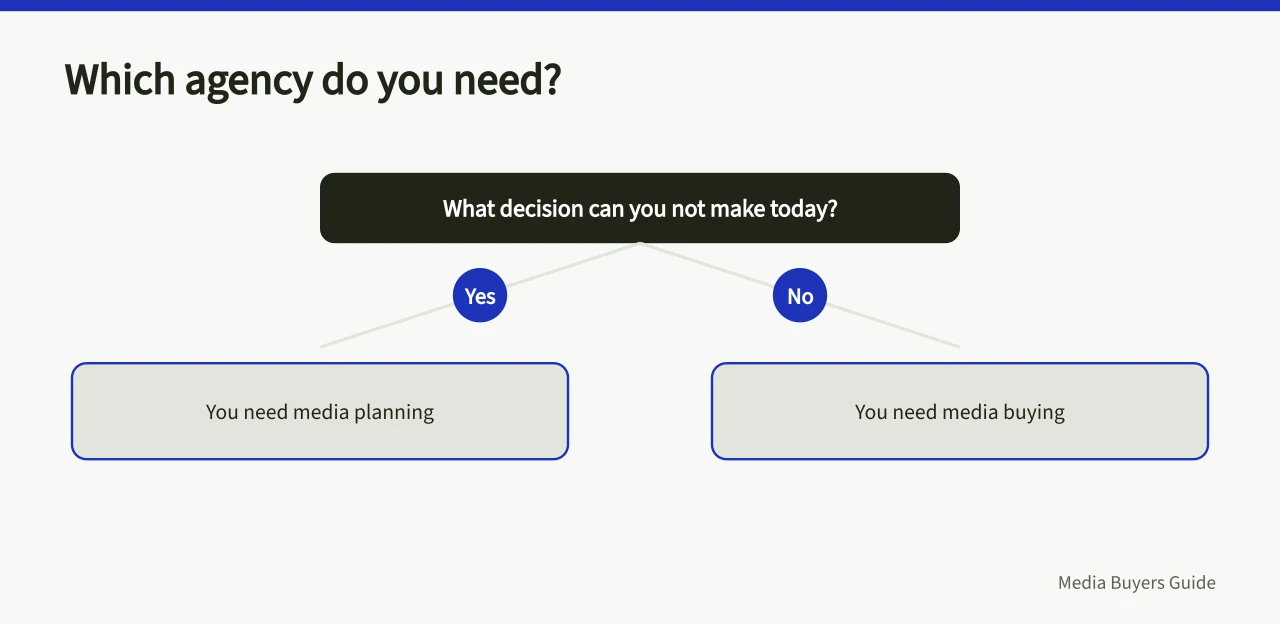
- Decision rulename the decision you cannot make today. If it is where to spend, you need planning. If it is how to buy cheaper or faster, you need buying.
Planning sets the argument, buying settles the price
Media planning answers why this audience, this channel and this month. Its main output is the brief that everything else is judged against. Media buying answers who gets the order and at what rate, then checks that the booked space ran.
Planning vs buying incentives
Media planning
- Core question
- Why this audience
- Main output
- The brief
- Rewarded for
- A plan that holds
- Risk if combined
- No check on trade
Media buying
- Core question
- Who gets the order
- Main output
- Bookings and rates
- Rewarded for
- Price and delivery
- Risk if combined
- No check on plan
The two jobs carry different incentives. A planner is rewarded for a plan that holds together. A buyer is rewarded for price and delivery. When one team does both, nobody is checking the other side of the trade.
Havas Media Network and Dentsu sell planning and buying under one roof.
Independent UK agencies include The7stars and Goodstuff. Croud and Brainlabs lead with digital planning and buying. A planning-led brief suits a contested category. A buying-led brief suits a fixed plan with high volume.
Where UK agency contracts draw the line
Trade-body templates from the IPA and ISBA commonly keep planning and buying as separate line items, with separate fees. That is why an agency can be strong on planning and thin on trading, or the reverse.
Scope schedule checks
- Are planning and buying separate line items?
- Which named people sit on each side?
- How do hours split between them?
- Is buying charged as commission, fee or media price?
- Is the contracting entity the operating agency?
Read the scope schedule, not the homepage. Ask which named people sit on each side, how hours split between them, and whether buying is charged as a commission, a fee or a media price. Our guide to who owns the brief, the plan and the build sets out the roles to look for before you compare anything else.
UK remuneration usually takes one of three forms. Commission is the oldest: the agency keeps a share of the media it buys, historically 15 per cent and now often 10 per cent or less on traditional media. A fee is agreed upfront, usually as a percentage of media spend or as a retainer based on hours.
Percentage fees typically sit between 2 and 10 per cent of spend, falling as the budget rises. As agent, the agency buys in your name and shows the media cost and its remuneration separately. As principal, it buys in its own name and resells at a margin, so you see one price.
Check the operating agency, not just the group. GroupM, Omnicom Media Group and Publicis Media are holding groups. The invoice may come from EssenceMediacom, OMD UK or Zenith. The7stars and Goodstuff contract as independent UK agencies.
The data and compliance split follows the same line
Planning usually decides which audiences get targeted, so data protection sits with that decision. If you build or buy audience segments, the ICO UK GDPR guidance hub is the reference for lawful basis, retention and subject rights.
Buying places the advertising, so the CAP advertising codes apply to what runs and where. Responsibility is shared between advertiser and agency, and the split should be named in the contract rather than assumed.
Comparing named UK agencies on planning and buying
Use the table to sort the appointment before you talk to anyone. It compares named agencies on ownership, planning and buying scope, and typical fit.
Appointment type comparison
Planning-led
- Main output
- Brief and channel roles
- First question
- What change do you need?
Buying-led
- Main output
- Bookings and rate evidence
- First question
- What is your budget and timing?
Full service
- Main output
- Both under one scope
- First question
- Both, in one meeting
Comparing named UK agencies
| Agency | Ownership | Planning and buying | Typical fit |
|---|---|---|---|
| GroupM (EssenceMediacom, Mindshare, Wavemaker, mSix&Partners) | WPP | Full service, large buying scale | Big advertisers with complex channel mix |
| Omnicom Media Group (OMD UK, PHD) | Omnicom | Full service, planning and buying | Brands wanting one scope |
| Publicis Media (Zenith, Starcom) | Publicis Groupe | Full service, planning and buying | Established advertisers |
| The7stars | Independent | Planning and buying for UK brands | Mid-sized UK advertisers |
| Goodstuff | Independent | Planning-led media planning and buying | Brands wanting senior planning |
| Croud | Independent, digital-first | Paid search, social and programmatic buying | Performance-led advertisers |
| Brainlabs | Independent, digital-first | Digital media planning and buying | Digital-first advertisers |
Use the second table to compare the appointment type itself.
Comparing named UK agencies
Planning-led agency
- Main output
- Brief and channel roles
- First question asked
- What change do you need?
- Main risk
- A plan that cannot be delivered
- Best fit
- New category or unclear channel mix
Buying-led agency
- Main output
- Bookings and rate evidence
- First question asked
- What is your budget and timing?
- Main risk
- The price paid for the audience
- Best fit
- Fixed plan with high volume
Full service
- Main output
- Both under one scope
- First question asked
- Both, in one meeting
- Main risk
- Blurred responsibility
- Best fit
- Large advertiser with an established plan
None of the agencies in the table is a pure play: each sells planning and buying together. For a genuinely planning-only appointment, look to independent media firms such as MediaSense and ID Comms, which shape the plan and review performance but do not trade media.
Deciding which one you need
- Check whether your current plan names channels, budgets and timings. A plan without numbers is a proposal, not a plan.
- Match the appointment to that gap, and say so in the brief. A planning-led pitch may come from Goodstuff or The7stars. A buying-led pitch may come from Croud or Brainlabs.
- If you appoint one agency for both, require the plan and the price to be presented as separate documents.
- Set a review date and a list of decisions the agency cannot make without you.
When splitting the two roles pays off
A split works when the plan is genuinely contested and the buying is routine, or when buying volume is large enough to justify a specialist trader. A planning-led independent such as The7stars or Goodstuff can sit beside a separate trader.
When splitting roles works
Split works
- Plan
- Genuinely contested
- Buying
- Routine or high volume
- Ownership
- Named owner per scope
Split fails
- Plan
- Assumed checked
- Buying
- Assumed checked
- Ownership
- No named owner
The planner delivers the brief, the channel roles and the budget split. The trader delivers the rate card, the bookings and the post-campaign delivery data.
It fails when two agencies each assume the other has checked the brief, the budget or the delivery dates. Nothing in either scope schedule will catch that by itself.
Give each appointment a named owner for the plan, the rate card and the reconciliation, then write those names into the scopes.
What to put in writing before you sign
Name the contracting entity, then check it at Companies House so the invoice matches the company you appointed. Confirm who owns the plan if you leave, how media is invoiced, and whether the agency buys as principal or agent.
Our checklist of seven matters to settle in writing covers the terms that usually decide whether a split appointment works in practice.
Common questions
Do I need a media buying agency if I already have a plan?
Only if the plan includes channels, budgets, timings and an audience. In that case a buying appointment can add price discipline and delivery checks without paying twice for strategy. Croud and Brainlabs are digital-first examples.
What does a media planning agency charge for?
Usually a fee for the strategy, the plan and the brief, sometimes with research or forecasting charged separately. It does not normally include the media cost itself. Independent planners such as The7stars or Goodstuff sit alongside group planners.
Can one agency do both planning and buying?
Yes, and most mid-sized UK agencies do. The risk is that the same team writes the plan and prices it, so ask for the two documents to be presented separately and reviewed by different people on your side.
How do I tell planning scope from buying scope in a proposal?
Look at the deliverables. Planning produces documents that describe intent. Buying produces bookings, rate evidence and post-campaign delivery data. Check which operating company signs in the proposal, and which team holds each side.